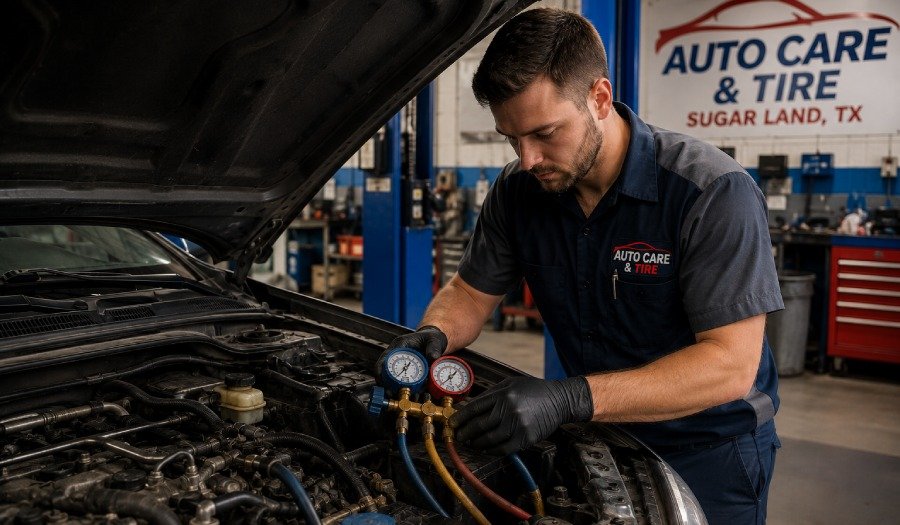
Car AC Repair in Sugar Land, TX: Causes, Costs & When to Get It Fixed
There’s nothing worse than climbing into your car on a hot Texas afternoon and realizing your air conditioning is blowing warm air instead of cold. In Sugar Land, where summer temperatures regularly climb past 95°F, a working car AC isn’t a luxury — it’s a necessity. If your car’s air conditioning has stopped cooling, started making strange noises, or simply isn’t working the way it used to, this guide will walk you through the most common causes, what to expect from repair costs, and how to find a trustworthy car AC repair shop in Sugar Land to get you back on the road in comfort. Why Is My Car AC Not Cooling? This is one of the most common questions car owners search for, and the honest answer is that there are several possible causes. Here are the most frequent culprits behind a car AC that won’t cool properly: 1. Low or Leaking Refrigerant Refrigerant is the fluid that actually absorbs heat from your cabin air and releases it outside. Over time, small leaks can develop in hoses, seals, or connections, causing refrigerant levels to drop. Once levels fall too low, your AC simply can’t produce cold air, even though the system still runs. 2. A Failing Compressor The compressor is the heart of your AC system — it pressurizes the refrigerant and keeps it circulating. When a compressor fails or its clutch stops engaging, the whole system stops working. Compressor failure is often accompanied by loud grinding or squealing noises. 3. Clogged or Blocked Condenser The condenser sits at the front of your vehicle and releases heat from the refrigerant. Dirt, debris, and road grime can block airflow through the condenser, reducing its ability to cool the refrigerant effectively. 4. Electrical Issues Modern car AC systems rely on sensors, relays, and fuses to operate correctly. A blown fuse or a faulty pressure switch can prevent the compressor from engaging at all, even if every mechanical part is in good shape. 5. Faulty Expansion Valve or Orifice Tube This small component regulates how much refrigerant enters the evaporator. If it becomes clogged or stuck, it can cause inconsistent cooling or a complete loss of cold air. Signs Your Car AC Is Failing Catching AC problems early can save you from a more expensive repair down the road. Watch for these warning signs: Warm or weak airflow — the AC runs but doesn’t cool the cabin effectively Unusual odors — a musty or moldy smell often points to mold buildup in the evaporator or cabin filter Strange noises — clicking, grinding, or squealing when the AC is turned on usually signals a compressor or belt issue Refrigerant leaks — an oily residue or puddle under the front of the vehicle Cycling on and off rapidly — the compressor engaging and disengaging repeatedly, often due to low refrigerant or an electrical fault Foggy or humid windows — a sign the AC isn’t properly dehumidifying the cabin air If you notice any combination of these symptoms, it’s worth scheduling a diagnostic before the underlying issue gets worse — or before the compressor fails completely, which is a far more expensive repair. Car AC Recharge vs. Repair: What’s the Difference? Many drivers assume that a “recharge” and a “repair” are the same thing, but they solve very different problems. AC Recharge A recharge simply adds refrigerant back into the system to restore cooling performance. It’s quick and relatively inexpensive, but it does not fix the root cause if refrigerant is escaping through a leak. Think of it as refilling a tire that has a slow puncture — it works temporarily, but the underlying problem remains. AC Repair A full repair addresses the actual cause of the problem — replacing a leaking hose, fixing a faulty seal, repairing or replacing the compressor, or clearing a blocked condenser. While it costs more upfront, a proper repair prevents the same issue from recurring every few months. Rule of thumb: if this is the first time your AC has lost refrigerant, a recharge combined with a dye test (to detect leaks) is a reasonable first step. If you’ve needed a recharge more than once, it’s time for a full diagnostic and repair. Car AC Repair Cost Near Me: What to Expect Repair costs vary widely depending on what’s actually wrong with your system. Keep in mind these are general ranges — the exact cost depends on your vehicle’s make and model, the age of the system, and the specific parts affected. The best way to get an accurate number is a hands-on diagnostic rather than guessing based on symptoms alone. Best Car AC Repair Shop in Sugar Land, TX When your AC stops working in the Texas heat, you want a shop that diagnoses the problem correctly the first time — not one that just tops off refrigerant and sends you on your way. Here’s what to look for in a trustworthy car AC repair shop: ASE-certified technicians with AC/refrigerant handling certification Proper leak-detection equipment (electronic detectors and UV dye testing) Transparent, upfront pricing before any work begins Warranty on parts and labor Genuine or high-quality OEM-equivalent replacement parts At Auto Care & Tire in Sugar Land, our technicians perform a full system diagnostic — checking refrigerant pressure, scanning for leaks, and inspecting the compressor, condenser, and hoses — before recommending any repair. That means you get an accurate diagnosis and a fair price, not a guessing game. How to Prevent Future AC Problems A little routine maintenance goes a long way toward keeping your AC running smoothly year-round: Run your AC for a few minutes even in cooler months to keep seals lubricated Replace your cabin air filter every 12,000–15,000 miles Get your AC system inspected once a year, ideally before summer Address small leaks early rather than waiting for a full system failure Ready to Fix Your Car AC? If your car’s AC isn’t blowing cold, don’t wait for the problem to get worse. Bring